Symbolic hypothesis generation with EML and qNS
Turn model-proposed formula trees into checked symbolic hypotheses using qNS masks, counterexample diagnostics, and proof-backed EML receipts.
This tutorial connects the two previous experiments. Tutorial 49 used a qNS Boolean-algebra carrier to filter candidate atoms. Tutorial 50 used EML trees as a tiny formula language. Here the two ideas are combined:
untrusted formula proposal
  -> qNS symbolic masks
  -> counterexample diagnostics
  -> proof-backed survivor manifest
The local command is:
python3 scripts/run_eml_neurosymbolic_loop_demo.py \
  --candidate-json experiments/eml_symbolic_hypothesis_fixtures/llm_candidates_v1.json
To create a proposal prompt and validate a returned candidate file, run:
python3 scripts/generate_eml_llm_proposal_packet.py \
  --llm-output experiments/eml_symbolic_hypothesis_fixtures/llm_candidates_v1.json
After one checked run, the feedback packet can condition the next prompt:
python3 scripts/generate_eml_llm_proposal_packet.py \
  --feedback-json results/local/eml-reproposal-feedback-packet.json \
  --llm-output experiments/eml_symbolic_hypothesis_fixtures/llm_candidates_v2_feedback.json \
  --prompt-out results/local/eml-llm-reproposal-prompt.md \
  --candidate-out results/local/eml-llm-reproposals.json \
  --validation-out results/local/eml-llm-reproposal-validation.json
It writes:
results/local/eml-neurosymbolic-loop-demo.json
results/local/eml-tau-sidecar-manifest.json
results/local/eml-reproposal-feedback-packet.json
results/local/eml-llm-proposal-prompt.md
results/local/eml-llm-proposal-validation.json
Scope
This is a symbolic-hypothesis scaffold, not native analytic Tau semantics. External proposals are treated as untrusted input. A formula is promoted only through explicit masks, bounded checks, and proof receipt metadata.
Part 0: the adaptive memory demo
The TauLang-Experiments repo now has a runnable memory demo for this loop. The public repo is:
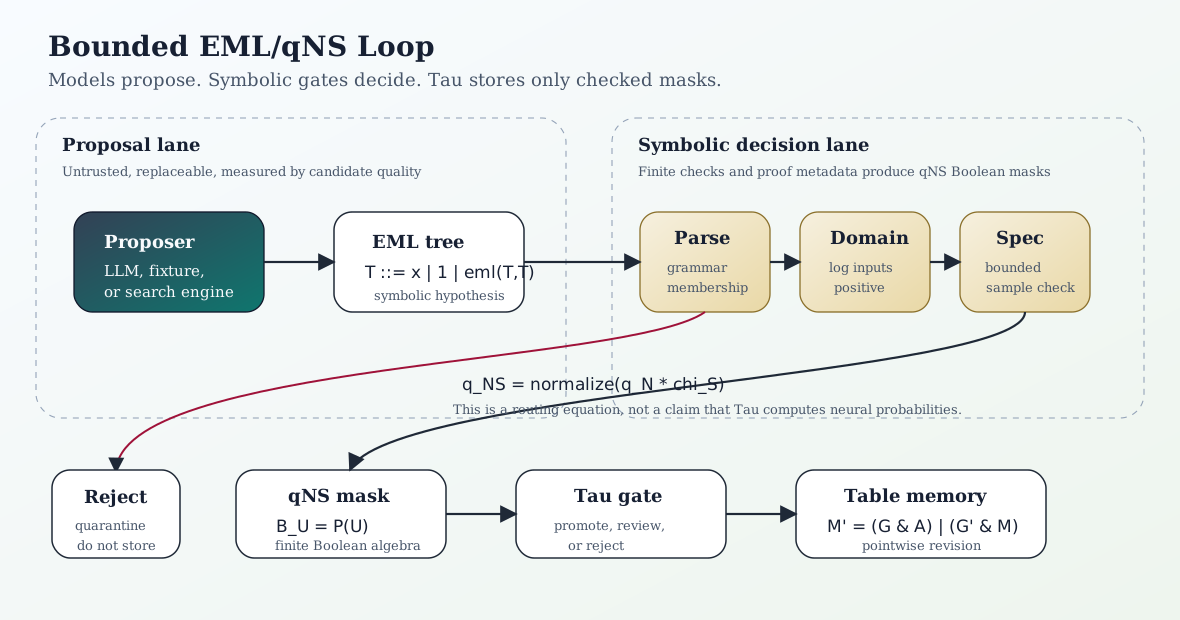
The full public reproduction path is:
git clone https://github.com/TheDarkLightX/TauLang-Experiments.git
cd TauLang-Experiments
./scripts/run_public_demos.sh --accept-tau-license
That script downloads Tau Language from the official IDNI repository, applies the community research patches locally, builds Tau, and runs the safe-table, qelim, qNS, EML/qNS certificate, and EML/qNS table-memory demos.
The memory-demo-only path is model-free by default, so it can be reproduced without a local LLM:
./scripts/run_eml_qns_llm_memory_demo.sh --accept-tau-license
The local-model path uses an installed Ollama model as the untrusted proposer:
./scripts/run_eml_qns_llm_memory_demo.sh \
  --accept-tau-license \
  --live-ollama \
  --model llama3.2:3b
In the local smoke test, llama3.2:3b produced five EML proposals. All five
parsed. Three were promoted by the Tau qns8 gate, two were routed to review,
and three memory slots were updated.
The reproducible fixture path currently reports:
candidate_count = 5
parse_ok_count = 3
promoted_count = 3
review_count = 2
memory_updated_count = 3
rejected_count = 2
rejected_preserved_count = 2
qns_table_regression_ok = true
symbolic_tau_table_check_ok = true
The JSON receipt can be checked without rerunning Tau:
python3 scripts/verify_eml_qns_memory_receipt.py
The demo runner invokes that verifier automatically. The verifier also mutates the receipt in memory and confirms that the broken rejected-row update is rejected.
The table memory is a finite map:
\[M : I \to B_{\mathrm{qNS}}.\]Standard reading. The memory-state symbol $M$ denotes a function from memory slots in $I$ to qNS Boolean-algebra values in $B_{\mathrm{qNS}}$.
Plain English. Each memory slot stores an evidence mask.
The update uses the same pointwise revision shape as the table tutorial:
\[M_{t+1}(i) = (G(i)\wedge A(i))\vee(G(i)'\wedge M_t(i)).\]Standard reading. The update equation says that, for each memory slot $i$, the next memory value is the join of two pieces: the replacement value $A(i)$ restricted by guard $G(i)$, and the old memory value $M_t(i)$ restricted by the prime of $G(i)$.
Plain English. Accepted evidence overwrites the selected slot. Rejected or review-routed evidence leaves the old slot unchanged.
Boundary.
This is a checked bounded witness for an MPRD-style loop: propose, check,
filter, and remember. It is not a general theorem that every model proposal is
good, not native analytic Tau semantics, and not full unrestricted TABA tables.
The current memory demo uses Tau qNS evidence functions and then performs the
memory update through a named Tau definition whose body is direct qns8 table
syntax:
memory_revise_qns8(old, guard, replacement) :=
  table { when guard => replacement; else => old }
The result artifact records the exact named call and the equivalent direct
table expression for every candidate. The harness also runs qns8 table
regressions for top guard, bottom guard, and partial guard cases. The companion
check uses table syntax over symbolic tau values to verify the same pointwise
revision shape.
Part I: the object being searched
The hypothesis language is still the EML grammar:
\[T ::= x \mid 1 \mid \operatorname{eml}(T,T), \qquad \operatorname{eml}(a,b)=\exp(a)-\ln(b).\]Standard reading. A tree $T$ is either the variable $x$, the constant $1$, or an EML node whose left and right children are trees. The value of $\operatorname{eml}(a,b)$ is the exponential of $a$ minus the natural logarithm of $b$.
Plain English. The search space is a formula forest built from one variable, one constant, and one operation.
Trap. In the real-valued demo, every logarithm argument must be positive. A proposed tree can be grammatically valid and still fail the real-domain guard.
Part II: qNS as candidate routing
For formula trees, the hard-filter loop is:
\[q_{\mathrm{NS}}(T\mid D) \propto q_{\mathrm{N}}(T\mid D)\, \chi_{\mathrm{parse}}(T)\, \chi_{\mathrm{domain}}(T,D)\, \chi_{\mathrm{spec}}(T,D).\]Standard reading. The filtered proposal weight for tree $T$ given data $D$ is proportional to the neural probability of $T$ given $D$, multiplied by three indicator functions: the parse indicator of $T$, the domain indicator of $T$ on $D$, and the specification indicator of $T$ on $D$.
Plain English. A model may propose a formula, but the filter deletes it if it is outside the grammar, invalid on the domain, or inconsistent with the checked examples.
Trap. The formula does not say that the model is trusted. It says that model mass is conditioned by symbolic gates.
The sidecar records those gates as finite masks:
proposed
domain_valid
spec_candidate
proof_supported
accepted
review
rejected
Standard reading. Each mask is a bitset over the reported candidate list. Candidate $i$ belongs to a mask exactly when bit $i$ is set in that mask.
Plain English. The report keeps the routing decision visible. A candidate can be rejected, accepted, or sent to human/proof review.
Part III: the LLM proposer surface
The proposal-packet script writes a prompt with the grammar, target list, real domain boundary, and required JSON schema. The demo then accepts a JSON proposal file:
{
  "schema": "eml_candidate_proposals_v1",
  "candidates": [
    {"target": "exp(x)", "origin": "llm_fixture", "expr": "eml(x,1)"},
    {"target": "ln(x)", "origin": "llm_fixture", "expr": "eml(x,eml(eml(x,x),1))"}
  ]
}
The parser accepts only:
x
1
eml(T,T)
So this proposal is rejected:
eml(x,0)
The reason is not that it is mathematically useless. The reason is narrower:
0 is not a terminal in this demo grammar.
Boundary. This is intentionally strict. The point of the file surface is to show how an LLM can propose formulas without gaining authority over the checker.
Part IV: counterexample diagnostics
For a target function $f$ and tree $T$, the sample error is:
\[\operatorname{MSE}(T,f) = \frac{1}{|G|} \sum_{x\in G}(T(x)-f(x))^2.\]Standard reading. The mean-squared error $\operatorname{MSE}(T,f)$ is the average, over sample points $x$ in $G$, of the squared difference between the value of tree $T$ at $x$ and the value of target function $f$ at $x$.
Plain English. The checker measures how badly the formula misses the target on the sample grid.
The demo also records counterexample diagnostics for rejected candidates. For example, a candidate may fail because evaluation reaches a logarithm of a non-positive value, or because a holdout point produces a large value error. In the current bounded run, those diagnostic points are added to the active sample grid before the final survivor list is emitted.
The same diagnostics are also emitted as a reproposal feedback packet:
results/local/eml-reproposal-feedback-packet.json
That packet is meant for the next proposer round. It lists accepted formulas, rejected formulas, diagnostic points, and the constraints the next proposal must respect.
Boundary. The feedback packet is not proof evidence. It is steering information. A new candidate still has to pass parsing, qNS masks, domain checks, sampled checks, and proof-receipt checks.
In the deterministic second-round fixture, the malformed proposal count drops from $1$ to $0$. The accepted formula set stays the same: one expression for $\exp(x)$ and two expressions for $\ln(x)$.
Standard reading. The comparison says that the second fixture has zero parse rejections and the same accepted source-expression set as the first fixture.
Plain English. The feedback packet improved proposal hygiene in this bounded test, but it did not discover a new accepted formula.
There is also a flagged identity-target extension:
python3 scripts/run_eml_neurosymbolic_loop_demo.py \
  --include-identity-target \
  --candidate-json results/local/eml-identity-proposals.json \
  --out results/local/eml-neurosymbolic-loop-demo-identity.json \
  --sidecar-out results/local/eml-tau-sidecar-manifest-identity.json \
  --feedback-out results/local/eml-reproposal-feedback-packet-identity.json
The accepted composed identity tree is:
\[\operatorname{eml}\bigl(1,\operatorname{eml}(\operatorname{eml}(1,\operatorname{eml}(x,1)),1)\bigr).\]Standard reading. The displayed tree is an EML node with left child $1$ and right child $\operatorname{eml}(\operatorname{eml}(1,\operatorname{eml}(x,1)),1)$. Under the abstract EML laws used by the Lean packet, it denotes $\ln(\exp(x))$, and therefore denotes $x$.
Plain English. The loop can now certify a composed formula, not just direct formulas for $\exp(x)$ and $\ln(x)$.
Boundary. This is still abstract-law evidence. It is not a theorem about all complex branch choices for logarithm, and it is not native Tau analytic semantics.
The composition extension adds the target $\exp(\exp(x))$:
python3 scripts/run_eml_neurosymbolic_loop_demo.py \
  --include-identity-target \
  --include-exp-exp-target \
  --candidate-json results/local/eml-composition-proposals.json \
  --out results/local/eml-neurosymbolic-loop-demo-composition.json \
  --sidecar-out results/local/eml-tau-sidecar-manifest-composition.json \
  --feedback-out results/local/eml-reproposal-feedback-packet-composition.json
Its accepted tree is:
\[\operatorname{eml}(\operatorname{eml}(x,1),1).\]Standard reading. The displayed tree is an EML node with left child $\operatorname{eml}(x,1)$ and right child $1$. Under the abstract EML laws used by the Lean packet, it denotes $\exp(\exp(x))$.
Plain English. The loop can now promote a formula built by placing a known survivor inside a larger checked context.
Boundary. This is a context-lifted survivor for one target. It is not arbitrary symbolic regression, not native Tau analytic semantics, and not a complete EML normalizer.
The next context-library fixture adds a second proved constructor:
\[\operatorname{WrapLog}(T)= \operatorname{eml}\bigl(1,\operatorname{eml}(\operatorname{eml}(1,T),1)\bigr).\]Together with $\operatorname{WrapExp}(T)=\operatorname{eml}(T,1)$, it accepts:
\[\operatorname{WrapLog}(\operatorname{WrapExp}(\operatorname{WrapExp}(x))) = \exp(x).\]Standard reading. The left side denotes the result of applying the exponential wrapper to $x$, applying the exponential wrapper again, and then applying the logarithm wrapper. Under the abstract law $\ln(\exp(a))=a$, the resulting denotation is $\exp(x)$.
Plain English. This is the first small constructor library for the EML proposal loop. The model can propose a larger formula, but the promotion still depends on named checked constructors and receipt metadata.
That suggests a safer proposal surface than raw strings:
Var
WrapExp(plan)
WrapLog(plan)
The constructor-plan compiler turns those plans into ordinary EML candidate JSON. The qNS loop then treats the compiled formula exactly like any other proposal.
Standard reading. A constructor plan is generated by the grammar above. The variable constructor denotes the base variable, the exponential-wrapper constructor denotes the result of applying the checked exponential context constructor to the subplan, and the logarithm-wrapper constructor denotes the result of applying the checked logarithm context constructor to the subplan.
Plain English. The model can work in a smaller language where every constructor has a named semantic law. That reduces proposal fragility without weakening the checker.
Boundary. Constructor plans do not bypass verification. They only produce candidate EML strings with theorem-lineage metadata.
The plan layer also has a small budget gate:
depth <= 3
WrapExp count <= 2
WrapLog count <= 1
The budgeted fixture accepts four plans and rejects three:
accepted: direct exp, exp-exp, log-exp identity, log-exp-exp
rejected: over-depth plan, unsupported WrapSin, missing WrapLog argument
Standard reading. The budget gate accepts a constructor plan only if it satisfies all three numeric bounds above and uses only constructors in the proved constructor set.
Plain English. The model can still propose bad plans, but bad plans are caught before they become raw EML candidates.
Boundary. The budget gate is proposal hygiene. Passing it does not mean the formula is correct.
The obligation audit then joins constructor plans to sidecar evidence:
constructor plan obligation
  -> matching interval-domain entry
  -> discharged or failed audit row
In the current run, four accepted plans produce eight obligations, and all eight are discharged by sidecar interval evidence.
Standard reading. The audit succeeds exactly when every recorded constructor obligation has a matching sidecar interval check and no matched interval violates the local guard condition.
Plain English. The audit turns a hidden assumption into a visible checklist.
Boundary. The checklist is bounded and local to this demo interval. It is not a global real-analysis proof.
The final promotion rule is:
promote iff qNS accepted, proof accepted, and obligation audit ok
A negative test tampers one audit row. The manifest then routes that candidate to review instead of promotion.
Standard reading. The promotion rule says that a constructor-plan candidate receives promoted status exactly when three recorded predicates all hold: the qNS gate accepts the candidate, the proof metadata accepts the candidate, and the obligation audit succeeds.
Plain English. The loop now has a fail-closed final gate. If any evidence layer breaks, the candidate is not promoted.
Finally, the constructor-plan feedback packet summarizes the next proposer state:
promoted_count = 4
review_count = 0
rejected_plan_count = 3
Standard reading. The packet records four promoted constructor plans, no promoted-plan review rows, and three rejected constructor plans from the budget and syntax layer.
Plain English. The next round starts with a compact map of what worked, what failed, and which rules must not be broken.
Boundary. The feedback packet is not trusted by itself. Every future plan must rerun all gates.
The second feedback-conditioned constructor-plan fixture gives the first measured loop improvement:
baseline rejected_plan_count = 3
second_round rejected_plan_count = 0
baseline promoted_count = 4
second_round promoted_count = 5
It adds this promoted plan:
\[\operatorname{WrapLog}(\operatorname{Var}) \rightsquigarrow \operatorname{eml}(1,\operatorname{eml}(\operatorname{eml}(1,x),1)).\]Standard reading. The constructor plan $\operatorname{WrapLog}(\operatorname{Var})$ compiles to the EML tree $\operatorname{eml}(1,\operatorname{eml}(\operatorname{eml}(1,x),1))$ and is promoted for the target $\ln(x)$ after the parser, qNS masks, proof metadata, and obligation audit all accept it.
Plain English. The feedback packet helped the next fixture avoid the three known bad plan shapes and include the missing direct-log plan.
Boundary. This is not evidence that arbitrary model feedback will improve. It is a checked second-round fixture over the current constructor language.
The loop also has a constructor-plan handoff contract now. The latest feedback can be rendered as a JSON-only prompt, and the returned plan file can be audited before compilation:
positive fixture: 5 compliant, 0 noncompliant
negative fixture: 1 compliant, 3 noncompliant
Standard reading. The compliance audit accepts a proposal row exactly when the row uses only allowed constructor operations, satisfies the active budget, and supplies every required constructor argument.
Plain English. Bad proposal shapes can be filtered before the EML parser and proof sidecar are even invoked.
Boundary. This audit is only proposal hygiene. It does not prove that a formula is true, useful, or semantically equal to a target.
The quarantine-first handoff runner then uses that audit before compilation:
positive handoff: 5 input rows, 0 quarantined, 5 promoted
negative handoff: 4 input rows, 3 quarantined, 1 promoted
Standard reading. The negative handoff run partitions the four proposal rows into three noncompliant rows and one compliant row. Only the compliant row is compiled and sent through qNS, proof metadata, obligation audit, and promotion.
Plain English. A bad proposal file no longer has to be all-or-nothing. The loop can quarantine the bad rows and still test the row that obeys the contract.
Boundary. Quarantine is not semantic proof. It is the safety wrapper around untrusted proposal input.
The deeper compression tactic is to decompose a plan into its constructor spine and remove checked equivalence pairs:
\[\operatorname{WrapLog}(\operatorname{WrapExp}(T)) \leadsto T.\]Standard reading. The rewrite applies only to a constructor-plan node whose outer constructor is $\operatorname{WrapLog}$ and whose child node has outer constructor $\operatorname{WrapExp}$. The replacement is the inner subplan $T$.
Plain English. The loop removes a log-after-exp wrapper before asking the rest of the checker to spend work on it.
The current equivalence-repair fixture reports:
changed rows = 4 / 4
total depth = 12 -> 4
promoted rows after v706 = 4
review rows after v706 = 0
Standard reading. The normalizer changes all four fixture rows. After normalization and rerunning the handoff gates with the direct identity receipt available, all four normalized rows are promoted.
Trap.
The earlier v705 run routed the direct Var row to review because the proof
sidecar lacked a direct receipt for Var as target $x$. v706 closes that
interface gap. This does not make the equivalence-repair pass complete.
Boundary. This equivalence-repair pass is a bounded repair normalizer, not a complete equality procedure for EML trees.
The opposite cancellation is guarded:
\[\operatorname{WrapExp}(\operatorname{WrapLog}(T)) \leadsto T \quad\text{only under an explicit converse-inverse law surface.}\]Standard reading. The constructor-plan normalizer may replace $\operatorname{WrapExp}(\operatorname{WrapLog}(T))$ by $T$ only if the row carries the semantic premise
\[\forall a,\quad \exp(\log(a))=a.\]For the real-valued demo interval, it also carries the local domain obligation that $\llbracket T\rrbracket$ stays positive.
Plain English. This is checked equivalence collapse with a receipt. The loop removes the redundant shape, but it keeps the law and domain conditions that make the removal valid.
The guarded fixture reports:
changed rows = 3 / 3
total depth = 8 -> 2
residual obligations = 2
promoted rows = 2
review rows = 1
Trap. The review row is intentional. For target $\ln(x)$, the residual value interval crosses below zero on $I=[0.25,3]$, so the guarded equivalence obligation is not discharged.
The law-surface split is now explicit. The base EML laws include:
\[\log(\exp(a))=a.\]The stronger bidirectional law surface adds:
\[\forall a,\quad \exp(\log(a))=a.\]Standard reading. The base law states that applying $\log$ after $\exp$ returns $a$. The stronger law surface additionally states that applying $\exp$ after $\log$ returns $a$ for every $a$ in the active semantic model.
Plain English. Log-after-exp is part of the base proof packet. Exp-after-log is not free. The demo promotes candidates using that direction only when the stronger law surface is selected explicitly.
Boundary. The stronger law surface is an abstract law surface. It is not, by itself, a proof about real numbers, complex branches, or native Tau analytic semantics.
The stronger proof-search compression is quotienting by the normalized representative:
\[P \sim Q \quad\Longleftrightarrow\quad \operatorname{target}(P)=\operatorname{target}(Q) \ \wedge\ \operatorname{normalize}(P)=\operatorname{normalize}(Q).\]Standard reading. Plans $P$ and $Q$ are equivalent under this quotient exactly when they have the same target and their normalized constructor plans are equal.
Plain English. The loop can prove or audit one canonical shape and attach the local rewrite history for every syntactic variant.
The quotient fixture reports:
rows = 9
classes = 3
quotient reduction = 6
total depth = 18 -> 6
promoted members = 7
review members = 2
Trap. The quotient is not a shortcut around obligations. A member whose residual obligation fails stays in review even if another member of the same canonical class promotes.
The machine-readable version is a local-obligation graph:
\[m \to \operatorname{class}(m), \qquad m \to o \quad\text{for every}\quad o\in\operatorname{Obl}(m).\]Standard reading. The member node $m$ has a dependency edge to its canonical class and a dependency edge to each local obligation $o$ in the obligation set of $m$.
Plain English. The graph shows exactly what must be checked before a candidate can be reused through a quotient class.
The current graph has 21 nodes and 18 dependency edges. It reduces nine member cases to three canonical proof targets, while keeping six rewrite obligations and three residual obligations visible.
The same quotient can be used as a representative-selection constraint:
\[|\operatorname{search\ tasks}| \quad:\quad 9 \longrightarrow 3.\]Standard reading. The number of search tasks is reduced from nine member cases to three selected representatives.
Plain English. Do not ask the prover or checker to solve the same shape nine times.
The selected representative set passes the downstream handoff with three promoted rows and zero review rows.
But this is a coverage claim, not an all-member claim:
\[\operatorname{HiddenBlocked}=2.\]Standard reading. The number of pruned members whose full quotient evidence routes them to review is two.
Plain English. Two discarded variants were not safe. They were discarded because a cleaner representative covered the class, not because the variants themselves passed.
That audit is now fed back into the proposer prompt. The prompt names the covered classes:
x       -> Var
exp(x)  -> WrapExp(Var)
ln(x)   -> WrapLog(Var)
It also names the blocked variants around $\ln(x)$, so the next proposal round does not keep spending budget on the same failed equivalent copies.
The loop then audits proposal behavior:
\[\operatorname{Waste}(P) = \operatorname{CoveredRepeats}(P) + \operatorname{HiddenBlockedRepeats}(P).\]Standard reading. The waste score of a proposal file $P$ is the sum of the number of proposal rows that repeat already covered classes and the number of proposal rows that repeat hidden blocked variants.
Plain English. Waste means spending proposal budget on shapes the loop already knows not to ask for in coverage mode.
In the deterministic comparison, the quotient-unaware fixture has waste $6+2=8$. The quotient-aware fixture has waste $0+0=0$ and contributes one novel class that promotes through the full handoff.
The sidecar also records a conservative interval-domain receipt for accepted formulas over the bounded demo interval:
\[I=[0.25,3].\]Standard reading. The interval symbol $I$ denotes the closed real interval whose lower endpoint is $0.25$ and whose upper endpoint is $3$.
Plain English. The interval-domain receipt checks whether each real-logarithm argument stays positive throughout $I$ under the current interval evaluator. This is stronger than “did the formula work on four points?”, and it still remains a bounded claim.
Trap. These diagnostics are not a completeness proof. They are evidence for why a bounded candidate was rejected and useful input for the next proposal round.
Part V: law surfaces and the bounded corpus
The law-surface demo artifact is:
assets/data/eml_law_surface_demo.json
The companion visualization is:
The JSON artifact is included directly. The longer research-cycle generator is intentionally not part of the beginner reproduction path.
The bounded corpus result is:
raw constructor plans               = 96
changed by normalization            = 72
target-consistent normalized rows   = 22
base-law promotions                 = 13
base-law review rows                = 9
BiLaws promotions                   = 20
BiLaws review rows                  = 2
The semantic switch is:
\[\mathcal{L}_{\mathrm{bi}} = \mathcal{L}_{\mathrm{base}} \cup \{\forall a,\ \exp(\log(a))=a\}.\]Standard reading. The bidirectional law surface $\mathcal{L}_{\mathrm{bi}}$ is the union of the base EML law surface and one additional law: for every admissible value $a$ in the active semantic model, applying $\log$ to $a$ and then applying $\exp$ returns $a$.
Plain English. The stronger law surface unlocks seven additional promotions in this bounded corpus, but it does not erase the remaining real-domain failures.
The final two review rows are still blocked because a positive-value interval obligation fails. In both cases, the relevant interval crosses below zero:
\[[-1.3862943611198904,\ 1.0986122886681098].\]Standard reading. The interval displayed above has a negative lower endpoint. Therefore it does not satisfy the local obligation that the value interval must be strictly positive.
Plain English. The stronger law surface helps with symbolic inverse laws. It does not make a logarithm argument positive when the interval evidence says otherwise.
Boundary. This is a bounded corpus result. It is ready as a demo of proof-hygienic symbolic hypothesis generation, not as a complete symbolic-regression engine.
Part VI: what gets promoted
The current promoted formulas are:
\[\operatorname{eml}(x,1)\]for $\exp(x)$,
\[\operatorname{eml}\bigl(1, \operatorname{eml}( \operatorname{eml}(1,\operatorname{eml}(\operatorname{eml}(x,1),1)), 1 ) \bigr)\]also for $\exp(x)$,
\[\operatorname{eml}(\operatorname{eml}(x,1),1)\]for $\exp(\exp(x))$, and
\[\operatorname{eml}(1,\operatorname{eml}(\operatorname{eml}(1,x),1)), \qquad \operatorname{eml}(x,\operatorname{eml}(\operatorname{eml}(x,x),1))\]for $\ln(x)$.
The manifest marks them as accepted because they pass the bounded checks and carry proof-backed normalizer metadata:
normalize_sound
normalize_stable
normalize_idempotent
normalize_certNorm_reaches
normalizeReceiptCanonZero_sound
Standard reading. The soundness theorem says that an expression and its normalized expression have the same evaluation. The stability theorem says that a normalized expression has no further accepted rewrite step. The idempotence theorem says that normalizing twice gives the same result as normalizing once. The certificate-reachability theorem says that when the finite certificate checker returns a normal form, the normalizer reaches the compiled expression of that normal form. The canonical-zero receipt theorem says that the receipt-producing normalizer preserves evaluation.
Plain English. Accepted formulas are not just strings that looked good in a sample. They are attached to named proof artifacts that explain what has actually been checked.
Part VII: what this gives Tau tooling
The practical feature is not that Tau suddenly computes arbitrary exponentials or logarithms. The practical feature is a safe sidecar lane:
Tau trace or spec context
  -> proposed symbolic formula
  -> qNS filter masks
  -> proof-backed accepted record
  -> explanation, threshold, score, or invariant candidate
This can support:
- compact score formulas learned from traces,
- explanation formulas attached to solver output,
- candidate ranking functions for search,
- invariant or cost-model proposals that must pass symbolic filters,
- proof-review queues where unsupported formulas are labeled
review, not silently accepted.
Boundary. The current implementation is a sidecar and demo loop. TauLang-Experiments can validate EML/qNS certificates, send finite evidence masks through Tau, and run a table-memory update demo. Native Tau does not yet evaluate analytic EML expressions as mathematical functions.
The Tau-facing public consumer lives in the experiment repo:
cd TauLang-Experiments
./scripts/run_eml_qns_demo.sh --accept-tau-license
./scripts/run_eml_qns_llm_memory_demo.sh --skip-setup-patch
The first command checks certificate masks and tamper rejection. The second
command uses Tau qns8 gates and a named table-backed memory revision:
memory_revise_qns8(old, guard, replacement) :=
  table { when guard => replacement; else => old }
Boundary. This does not mean Tau evaluated $\exp$, $\ln$, or EML trees. It means accepted sidecar evidence was converted into finite qNS masks, passed through Tau, and used to decide whether table memory should update or remain unchanged.
Part VIII: bounded symbolic regression
The next artifact moves one step closer to regression:
assets/data/eml_bounded_symbolic_regression.json
It is generated by:
python3 scripts/run_eml_bounded_symbolic_regression.py
This script does not start from hand-written candidate proposals. It enumerates the bounded EML corpus and asks which tree best fits a small train-and-holdout dataset.
The bounded search surface is:
\[\mathcal{T}_{\le d} = \{T \mid \operatorname{depth}(T)\le d\}.\]Standard reading. The bounded tree set $\mathcal{T}_{\le d}$ denotes the set of all EML trees whose depth is less than or equal to $d$.
Plain English. The search only ranges over EML trees up to the chosen depth bound.
For each target dataset $D$, the selected formula is:
\[T^\star = \min_{\prec} \{T\in\mathcal{T}_{\le d} \mid \operatorname{err}_{\mathrm{train}}(T,D)\le\varepsilon \wedge \operatorname{err}_{\mathrm{holdout}}(T,D)\le\varepsilon \}.\]Standard reading. The selected tree $T^\star$ is the $\prec$-least tree among the trees $T$ in $\mathcal{T}_{\le d}$ whose training error on $D$ is at most $\varepsilon$ and whose holdout error on $D$ is at most $\varepsilon$. Here $\prec$ is the declared bounded-corpus ordering used to break ties.
Plain English. Among the bounded trees that fit both the training points and the holdout points, choose the smallest one under the declared ordering.
The current run uses $d=3$, $\varepsilon=10^{-9}$, and a corpus of $1446$ trees. It finds minimal bounded fits for:
| Target | Best bounded fit |
|---|---|
| $x$ | x |
| $\exp(x)$ | eml(x,1) |
| $\ln(x)$ | eml(1,eml(eml(1,x),1)) |
| $\exp(\exp(x))$ | eml(eml(x,1),1) |
The checked summary is:
target_count = 4
all_targets_fit = true
all_best_minimal = true
proof_receipt_accept_count = 4
symbolic_identity_accept_count = 4
Standard reading. The artifact has four target datasets, every target has at least one bounded fit, every selected best fit is minimal within the bounded corpus order, four selected fits have accepted proof receipts, and four selected fits pass the symbolic identity check.
Plain English. This is a small but real regression loop: enumerate formulas, fit data, choose minimal survivors, then attach proof metadata where the known proof surface supports the survivor.
Trap. This is not full symbolic regression. It is bounded enumerative regression over $\mathcal{T}_{\le 3}$. It does not prove that no deeper formula fits, it does not reproduce the EML paper’s gradient search, and it does not make Tau a native analytic solver.
Part IX: noisy regression certificates
Exact-fit demos are useful, but practical regression often has noisy data. The next artifact is:
assets/data/eml_noisy_regression_certificates.json
It is generated by:
python3 scripts/run_eml_noisy_regression_certificates.py
For noisy data, the selected tree is the lexicographic minimizer:
\[T^\star = \operatorname*{arg\,min}_{T\in\mathcal{T}_{\le d}} \bigl( \operatorname{MSE}_{\mathrm{noisy}}(T), \operatorname{MSE}_{\mathrm{holdout}}(T), |T|, \operatorname{depth}(T), \operatorname{repr}(T) \bigr).\]Standard reading. The selected tree $T^\star$ is an element of $\mathcal{T}_{\le d}$ that minimizes the displayed ordered tuple: noisy training mean-squared error, holdout mean-squared error, tree size, tree depth, and tree representation.
Plain English. First fit the noisy training data as well as possible. If there is a tie, prefer better holdout behavior, then the smaller and simpler expression.
The residual certificate records:
\[r_i(T)=T(x_i)-y_i.\]Standard reading. The residual symbol $r_i(T)$ denotes the signed residual of tree $T$ at sample index $i$: the value computed by $T$ at input $x_i$ minus the observed value $y_i$.
Plain English. The report does not only name a winner. It records the signed error at each checked point.
The current noisy run uses the same depth-3 corpus of $1446$ trees and three noisy targets:
| Noisy target | Selected formula |
|---|---|
| noisy $\exp(x)$ | eml(x,1) |
| noisy $\ln(x)$ | eml(1,eml(eml(1,x),1)) |
| noisy $\exp(\exp(x))$ | eml(eml(x,1),1) |
The checked summary is:
target_count = 3
winner_count = 3
proof_receipt_accept_count = 3
symbolic_identity_accept_count = 3
Standard reading. The artifact has three noisy target datasets, three selected winners, three accepted proof receipts for the selected winners, and three selected winners whose symbolic identity checks are accepted.
Plain English. The bounded search recovers the compact clean formulas even when the training values are perturbed by small deterministic noise.
Trap. This is still not statistical learning theory. The certificate proves what won inside the declared finite corpus and records its residuals. It does not prove that the winner is the true data-generating law.
Part X: regression winners as qNS certificates
The next bridge turns regression winners into qNS-style certificate masks:
assets/data/eml_regression_certificate_manifest.json
It is generated by:
python3 scripts/generate_eml_regression_certificate_manifest.py \
  --tau-bin external/tau-lang-qns-ba/build-Release/tau
Before running this command directly, build the patched qNS Tau checkout from Tutorial 49:
./scripts/run_qns_semantic_ba_demos.sh
Each accepted regression winner must carry seven finite evidence bits:
| Bit | Meaning |
|---|---|
grammar_bounded |
the formula came from the declared bounded EML corpus |
fit_passed |
the source artifact’s fit objective passed |
holdout_passed |
the source artifact’s holdout objective passed |
minimality_scoped |
minimality or rank is scoped to the declared bounded corpus |
proof_receipt |
the selected formula has accepted proof metadata |
symbolic_identity |
the selected formula passed symbolic identity checking |
residual_certificate |
the source artifact records error or residual data |
The promotion condition is:
\[M_{\mathrm{accepted}}\wedge M_{\mathrm{required}} = M_{\mathrm{required}} \quad\wedge\quad M_{\mathrm{review}}=0.\]Standard reading. The meet of the accepted mask and the required mask is equal to the required mask, and the review mask is zero. Equivalently, every required evidence bit is present in the accepted mask, and no review blocker bit is present.
Plain English. Every required evidence bit must be present, and no review blocker may remain.
The checked manifest summary is:
certificate_count = 7
promoted_count = 7
review_count = 0
tau_blocker_count = 0
exact_source_count = 4
noisy_source_count = 3
Standard reading. The manifest contains seven regression certificates, seven promoted certificates, zero certificates routed to review, zero Tau blocker masks, four certificates from the exact bounded source, and three certificates from the noisy bounded source.
Plain English. All current exact and noisy EML regression winners can be consumed through the same finite qNS evidence-mask interface.
Trap. The qNS certificate does not strengthen the underlying regression theorem. It only prevents a winner from being promoted unless the declared evidence fields are present and Tau agrees that the finite evidence mask is complete.
Part XI: fail-closed regression certificates
The happy path is not enough. The certificate wrapper also needs negative tests. The fail-closed artifact is:
assets/data/eml_regression_certificate_failclosed.json
It is generated by:
python3 scripts/verify_eml_regression_certificate_failclosed.py \
  --tau-bin external/tau-lang-qns-ba/build-Release/tau
This uses the same patched qNS Tau binary built by
scripts/run_qns_semantic_ba_demos.sh.
The verifier accepts a row only when:
\[H_{\mathrm{row}}=H_{\mathrm{source}} \quad\wedge\quad M_{\mathrm{accepted}}\wedge M_{\mathrm{required}}=M_{\mathrm{required}} \quad\wedge\quad M_{\mathrm{review}}=0.\]Standard reading. The row hash $H_{\mathrm{row}}$ is equal to the current source-artifact hash $H_{\mathrm{source}}$, the bitwise conjunction of the accepted mask and the required mask is equal to the required mask, and the review mask is zero.
Plain English. The certificate must point to the current source artifact, include every required evidence bit, and carry no review blocker.
The negative corpus mutates each valid certificate in four ways:
drop proof_receipt
drop residual_certificate
force review_required
stale source hash
The checked summary is:
valid_count = 7
valid_promoted_count = 7
tampered_count = 28
tampered_rejected_count = 28
tau_rejected_count = 21
hash_rejected_count = 7
Standard reading. The artifact contains seven valid rows, seven valid promoted rows, twenty-eight tampered rows, twenty-eight rejected tampered rows, twenty-one tampered rows rejected by the Tau mask check, and seven tampered rows rejected by the source hash check.
Plain English. The wrapper now has a negative test surface, not only a success path. Missing proof bits, missing residual bits, review blockers, and stale source hashes do not promote.
Trap. This is not a cryptographic attestation system. The hash check is a local artifact-integrity check, and it does not protect against a compromised verifier.
Part XII: demo gallery
The tutorial now has one public gallery artifact:
assets/data/eml_qns_demo_gallery.json
It separates the slow and fast parts of the experiment.
The slow lane is bounded EML regression. It searches a finite corpus and records which formula wins under the declared objective.
The fast lane is Tau qns8 certificate gating. It does not rediscover the
formula. It checks whether the returned certificate has the required evidence
bits and no blocker bits.
The negative lane is the fail-closed test corpus. It checks that tampered certificates do not promote.
The current gallery summary is:
slow_source_count = 2
fast_promoted_count = 7
negative_rejected_count = 28
Plain English. This is the demo shape readers should remember: expensive search can happen outside Tau, but the artifact that enters Tau is small, finite, auditable, and rejected when required evidence is missing.
Trap. The gallery does not add neural proposal generation. It shows the symbolic side of the loop that a neural proposer would have to satisfy.
Part XIII: next work
The next upgrades are deliberately concrete:
- strengthen the conservative interval checker into a richer range checker,
- add a richer domain type system for real, positive-real, and complex-branch assumptions,
- emit certificate traces for more discovered formulas,
- let a real LLM proposer write the JSON proposal file,
- use the reproposal feedback packet to drive a second external proposal round,
- promote only formulas whose proof receipt matches the intended use.
The method is:
models propose;
symbolic gates decide;
proof artifacts promote;
counterexamples steer the next proposal.