Find the symmetry
A concise path from antisymmetry and equality to Tao's symmetry method, group actions, matrix representations, invariant pieces, Fourier analysis, and time reversal.
Mathematicians use the word symmetry in several nearby but different ways. Three of them are easy to confuse:
| Idea | Exact role |
|---|---|
| Antisymmetry | A rule that can turn two opposite comparisons into equality |
| Tao’s symmetry tactic | Find transformations that leave the problem unchanged, then use them to reduce or organize the proof |
| Representation theory | Encode abstract symmetries as linear transformations and split the resulting space into simpler invariant pieces |
They belong to the same larger story about structure, but they are not the same theorem.
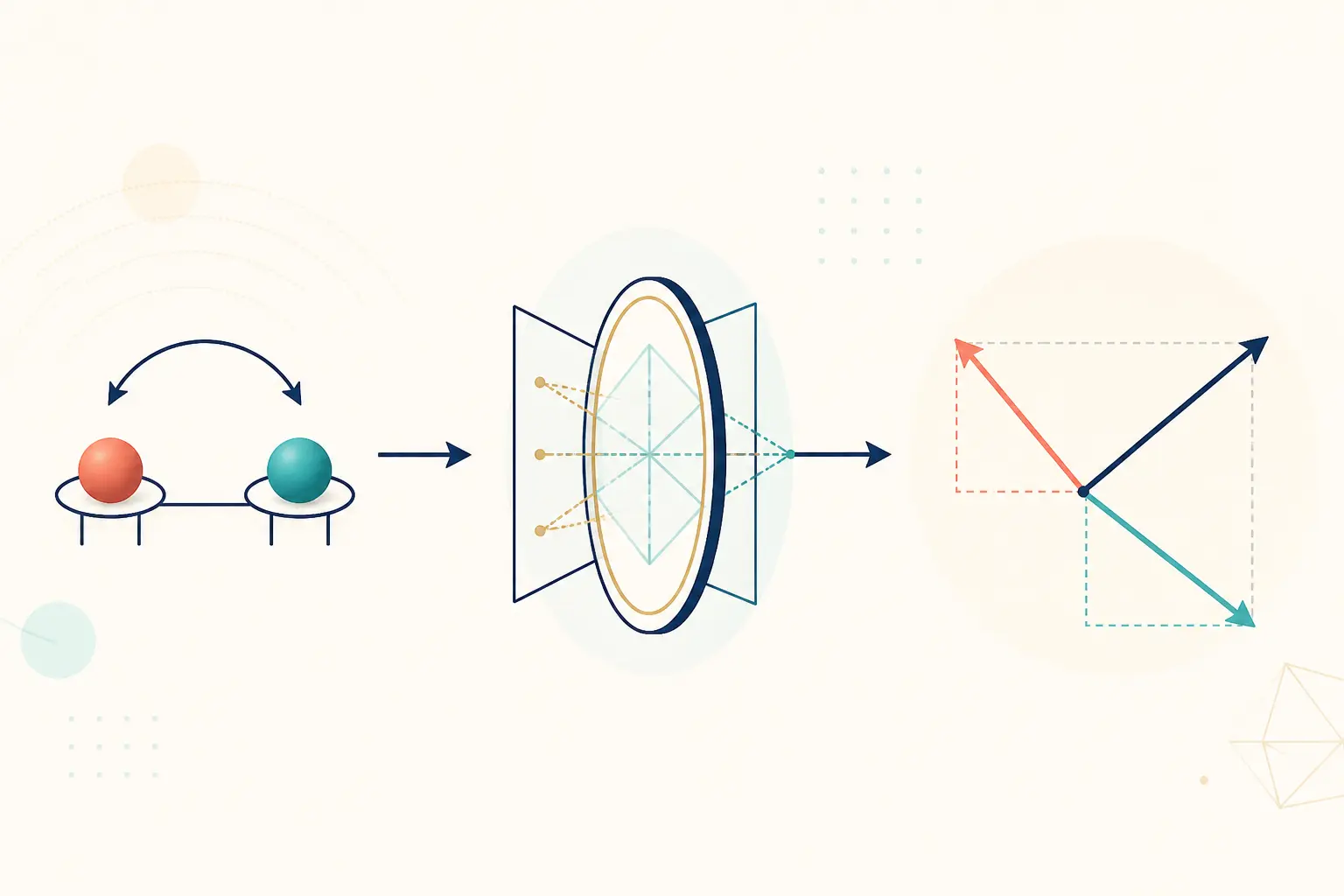
1. How antisymmetry produces equality
For ordinary numbers,
\[A\leq B \quad\text{and}\quad B\leq A \quad\Longrightarrow\quad A=B.\]Read exactly:
“If
Ais less than or equal toB, andBis less than or equal toA, thenAequalsB.”
This works because the relation “less than or equal to” is antisymmetric.
For a general relation written as a R b, antisymmetry means:
Read exactly:
“For every
aand everyb, ifais related byRtobandbis related byRtoa, thenaequalsb.”
Here R is an ordinary Latin capital letter naming an unspecified relation. It is not the Greek letter rho.
Antisymmetry does not mean “the relation works equally in both directions.” That property is symmetry. Equality itself is symmetric because
\[A=B\quad\Longrightarrow\quad B=A.\]The double-inequality proof is perfectly valid. A further structural question is:
What common object, invariant, or decomposition makes the equality inevitable?
That question leads toward the kind of hidden structure emphasized in deep proof discovery.
The Noether-style question
The proof by two inequalities certifies equality. The deeper question associated with Emmy Noether’s proof style is whether one object or invariant explains both sides at once.
In the example below, that object is a decomposition into a part preserved by swapping and a part reversed by swapping. Equality becomes inevitable when the reversed part is zero. This is one example of an “inner ground,” not a claim that every equality must be explained by representation theory.
2. The two-seat symmetry game
Imagine two numbered seats containing values x and y:
seat 1          seat 2

   x               y
The game has only two cards:
LEAVE ALONE, e        SWAP, s

(x, y) -> (x, y)      (x, y) -> (y, x)
Its rules are exact:
echanges nothing.sexchanges the seats.- Swapping twice changes nothing, so
s² = e. - The seat values may be added and scaled, so the game takes place in a vector space.
The story maps to the mathematics as follows:
| Game object | Mathematical object |
|---|---|
| Two seats | Two coordinate directions in V = ℝ² |
| Leave-alone and swap cards | Elements e and s of a symmetry group |
| Playing a card | Applying the group action |
| Total and difference | Two invariant directions |
Nothing in the later proof depends on the furniture story. The seats only make the transformation rule visible.
Before introducing matrices, the game predicts two hidden directions:
total       x + y     unchanged by the swap

difference  x - y     changes sign under the swap
Indeed,
\[x+y=y+x,\]while
\[x-y=-(y-x).\]The equality test also becomes visible:
\[x=y \quad\Longleftrightarrow\quad x-y=0.\]Read exactly:
“
xequalsyif and only if the differencexminusyequals zero.”
Within this model, the swap does nothing to the ordered pair precisely when the difference component vanishes. This exposes a structural reason for equality, not merely a second route to the same conclusion.
3. What Tao means by finding symmetry
Terence Tao uses symmetry in a broad problem-solving sense. The practical questions are:
- Which transformations leave the hypotheses and conclusion unchanged?
- Which cases are merely transformed copies of one another?
- Can one representative be chosen from each family of equivalent cases?
- Can the proof preserve the symmetry instead of introducing an arbitrary bias?
- Can a symmetry be “spent” to choose a convenient normal form?
In the two-seat game, (x,y) and (y,x) lie in the same orbit, meaning that one can be reached from the other by an allowed symmetry. A symmetric claim need not be proved twice for those two descriptions.

Alternative lens: a two-state machine
The progressive swaps can also be viewed as a deterministic finite-state machine. Fix values x and y, assume x ≠ y, and name the two visible configurations:
State A: (x,y)
State B: (y,x)

          SWAP
    A <----------> B
          SWAP
The machine accepts two input commands, LEAVE and SWAP. Its complete transition table is:
| Current state | LEAVE |
SWAP |
|---|---|---|
A = (x,y) |
A |
B |
B = (y,x) |
B |
A |
This is deterministic because the current state and command determine exactly one next state. It is reversible because SWAP is a bijection: each state has exactly one state that swaps into it.
The game now predicts the result of any number of swaps. For every nonnegative integer n,
Read exactly:
“
sto the powern, applied to stateA, equals stateAifnis even, and equals stateBifnis odd.”
The finite-state-machine view and the symmetry view describe the same small process, but they make different questions easy:
| Lens | Question made visible |
|---|---|
| Finite-state machine | Which configuration comes next after a command? |
Group C₂ |
How do LEAVE and SWAP compose? |
| Group action | Which configurations belong to the same orbit? |
| Matrix representation | Which linear components stay fixed or change sign? |
More than one representation can be useful because each preserves the same transition rule while exposing a different kind of structure.
Boundary: the two-state machine records only the two configurations and their transitions. It does not, by itself, expose addition, scaling, the symmetric direction, or the antisymmetric direction. Representation theory adds that linear structure. If x = y, states A and B are the same visible configuration, so the minimal machine has one state with a SWAP self-loop. If other operations can alter the values, the full state space may be larger even though the order controller still toggles between “original” and “swapped.”
This is not the same as antisymmetry of ≤.
antisymmetry of a relation
    opposite comparisons can force equality

symmetry of a problem
    transformations preserve the problem
Tao’s tactic is also broader than representation theory. It applies to nonlinear substitutions, geometric motions, rescalings, relabelings, and other transformations that may not be linear.
4. Representation theory makes the symmetry linear
The two game cards form a group:
\[G=\{e,s\}, \qquad s^2=e.\]Let the seat values live in the vector space
\[V=\mathbb{R}^2.\]A representation assigns an invertible linear transformation to every group element:
\[\rho:G\longrightarrow \operatorname{GL}(V).\]Read exactly:
“Rho is a function from the group
Gto the general linear group ofV.”
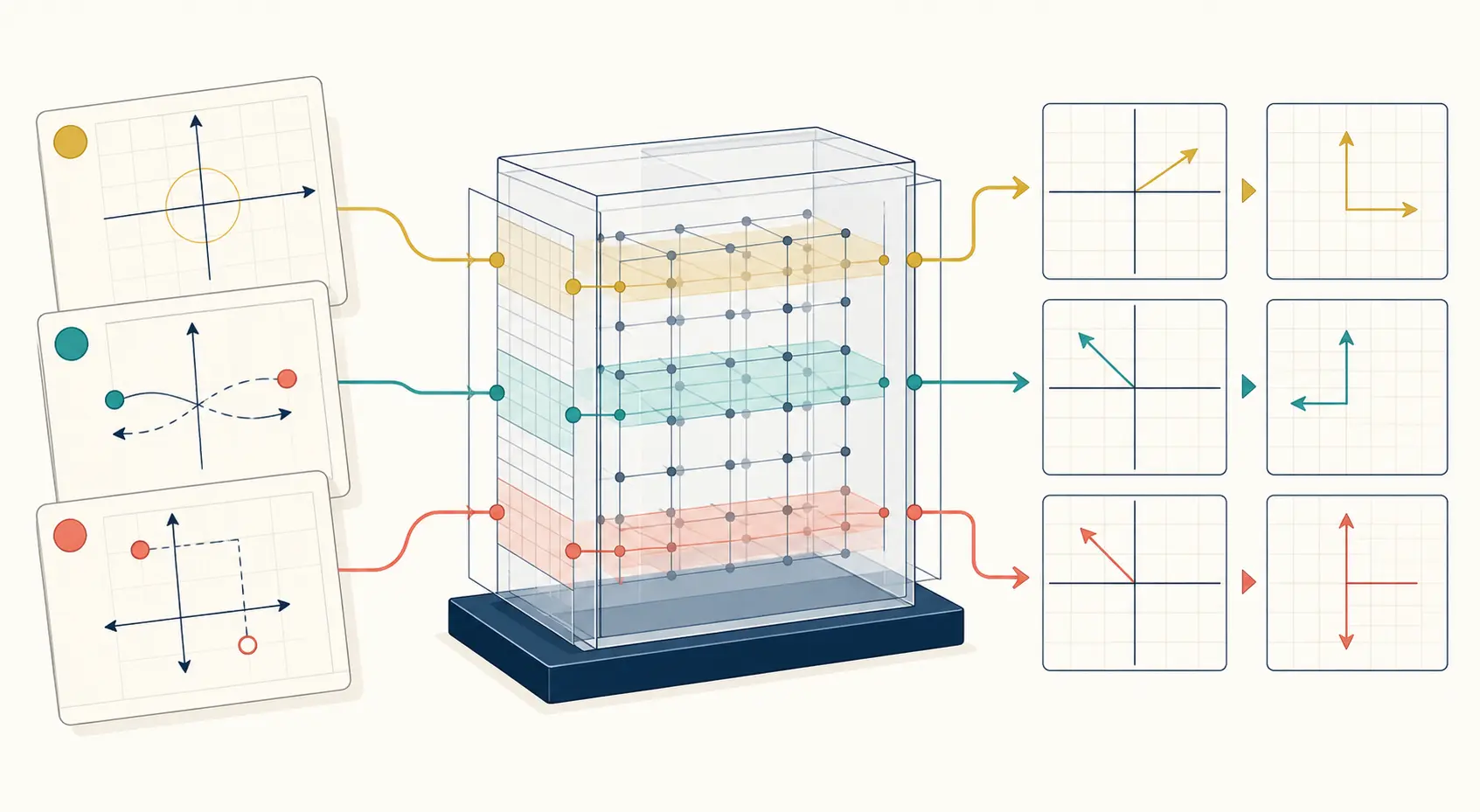
The symbol ρ is lowercase Greek rho, pronounced “row.” It resembles a lowercase p, but it is a different character. In this declaration, the colon means “is a function of the following type,” not “such that.”
GL(V) is the group of all invertible linear transformations from V to itself.
For the swap game,
\[\rho(e)= \begin{pmatrix} 1&0\\ 0&1 \end{pmatrix}, \qquad \rho(s)= \begin{pmatrix} 0&1\\ 1&0 \end{pmatrix}.\]Multiplying the swap matrix by a column vector gives
\[\rho(s) \begin{pmatrix} x\\y \end{pmatrix} = \begin{pmatrix} y\\x \end{pmatrix}.\]The swap is reflection across the fixed line
The assignment must preserve the group law:
\[\rho(gh)=\rho(g)\rho(h), \qquad \rho(e)=I.\]Read exactly:
“Rho of the product
g hequals rho ofgmultiplied by rho ofh, and rho of the identity element equals the identity transformation.”
The matrices therefore reproduce the same composition rules as the abstract symmetries.
5. The hidden pieces
The swap matrix looks even simpler in the right coordinates. Define
\[u= \begin{pmatrix}1\\1\end{pmatrix}, \qquad v= \begin{pmatrix}1\\-1\end{pmatrix}.\]Then
\[\rho(s)u=u, \qquad \rho(s)v=-v.\]The line spanned by u is the symmetric direction. The line spanned by v is the antisymmetric direction. Each line is invariant because the swap sends every vector on that line back onto the same line.
Over the real numbers,
\[\begin{pmatrix}x\\y\end{pmatrix} = \frac{x+y}{2} \begin{pmatrix}1\\1\end{pmatrix} + \frac{x-y}{2} \begin{pmatrix}1\\-1\end{pmatrix}.\]Read exactly:
“The vector with coordinates
xandyequals one half ofx+ytimes the symmetric vector, plus one half ofx-ytimes the antisymmetric vector.”
Now the equality condition has a geometric form:
\[x=y \quad\Longleftrightarrow\quad \frac{x-y}{2}=0.\]The pair lies entirely in the symmetric line exactly when its antisymmetric component disappears.
One vector, two invariant directions
The corresponding projection operators are
\[P_{+}=\frac{I+\rho(s)}{2}, \qquad P_{-}=\frac{I-\rho(s)}{2}.\]P₊ keeps the symmetric part. P₋ keeps the difference part. They turn the informal instruction “find what remains unchanged” into an exact calculation.
6. The general representation-theory workflow
find the transformations that preserve the problem
                         |
                         v
collect their composition rules into a group G
                         |
                         v
encode their action as rho : G -> GL(V)
                         |
                         v
split V into invariant pieces
                         |
                         v
solve the simpler pieces and reconstruct the answer
This is useful because one large matrix problem may become several smaller independent problems. The same idea appears in:
- geometry, through rotations and reflections;
- physics, through conserved quantities and particle symmetries;
- chemistry, through molecular symmetry;
- number theory, through group actions on algebraic objects;
- graph theory, through automorphisms and orbit counting;
- Fourier analysis, through translation symmetry.
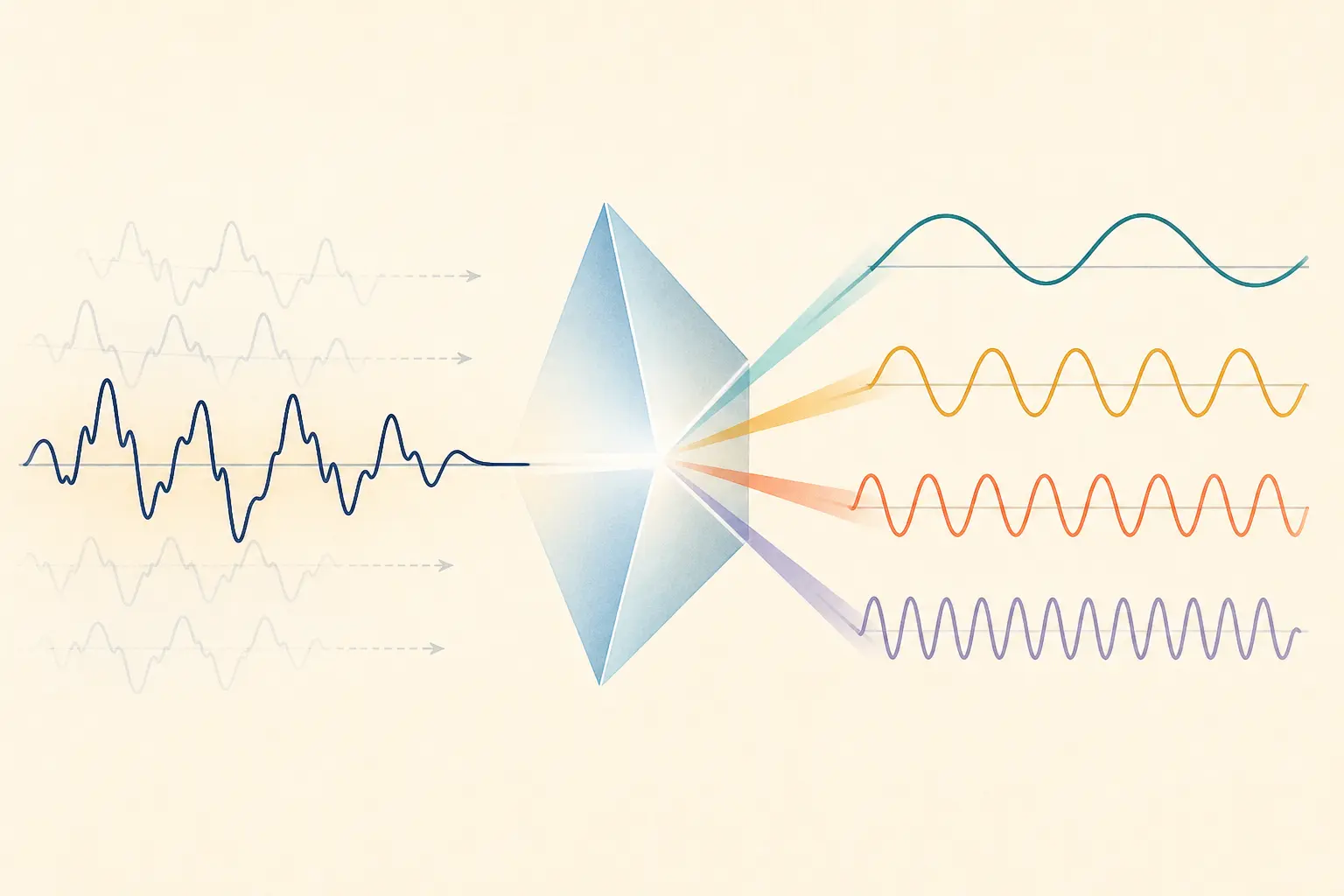
In familiar abelian translation settings, Fourier waves are one-dimensional representation modes. Translation acts on each mode by multiplying it by a phase. A complicated signal can therefore be split into simple components that do not mix under translation. Fourier analysis is one especially important instance of the representation-theory pattern.
7. Time as a mathematical symmetry
Abstract mathematics does not force time to have one shape. A model must declare what its time object is and which structure matters.
| Time model | Structure supplied by the model |
|---|---|
The real line ℝ |
A continuous coordinate with two directions |
| An ordered real line | A distinguished earlier-to-later order |
A circle S¹ |
A periodic coordinate that returns to its starting value |
A Lorentzian spacetime (M,g) |
Light cones and possible causal paths |
A set of histories Sol |
The trajectories permitted by a dynamical law |
This is Tao’s symmetry question in a clean form:
Which transformation preserves the particular time structure under study?
Reflection of the time line
Suppose time is represented by the real line and an origin has been chosen:
\[T=\mathbb{R}.\]Define
\[R(t)=-t.\]Read exactly:
“
Roftequals negativet.”
Applying the map twice gives
\[R(R(t))=t.\]Read exactly:
“
RofRoftequalst.”
Thus R² is the identity. Time reflection has the same two-element group structure as the seat swap from the opening game.
What it preserves depends on the model. Reflection preserves distances on the real line:
\[|R(t_1)-R(t_2)|=|t_1-t_2|.\]Read exactly:
“The absolute value of
Roft₁minusRoft₂equals the absolute value oft₁minust₂.”
It reverses the usual order:
\[t_1<t_2 \quad\Longrightarrow\quad R(t_1)>R(t_2).\]The same map is therefore a symmetry of the metric line, but not an order-preserving symmetry of the ordered line. “Time is symmetric” has no single truth value until the structure has been named.
Three different mathematical questions about time
Reversing a complete history
Let z(t) denote a complete state. Let Θ specify which state variables reverse. Define
Read exactly:
“
zsubRoftequals theta applied tozof negativet.”
For ordinary position q and momentum p, the familiar transformation is
Let Sol be the set of histories admitted by a declared model. Time reversal is a symmetry of that model when
This is the exact version of running a mathematical movie backward. It is a statement about the solution space.
Time translation is another transformation:
\[T_a(t)=t+a.\]The translations compose by addition:
\[T_a\circ T_b=T_{a+b}.\]Under the hypotheses of Noether’s theorem, continuous time-translation symmetry of the action yields conservation of energy. This is a direct example of symmetry exposing an invariant.
The stronger mathematics of return paths
Reversing a movie and returning to an earlier spacetime event are different constructions. General relativity represents spacetime by a Lorentzian manifold (M,g). A possible history is a curve
A closed timelike curve satisfies
\[\gamma(0)=\gamma(1),\]and, using the metric-sign convention (-,+,+,+),
Read exactly:
“Gamma at zero equals gamma at one.”
and:
“The metric
gat gamma ofs, applied to the tangent vector gamma dot ofstwice, is less than zero for everysin the closed interval from zero to one.”
Together with a consistent future direction, the second condition says that the curve’s tangent is timelike and future-directed along the loop. The first says that it returns to the same spacetime event, not merely the same place. Some mathematical solutions of Einstein’s field equations contain such curves.
There is also a clean obstruction. Suppose a spacetime has a global time function
\[\tau:M\longrightarrow\mathbb{R}\]that strictly increases along every future-directed causal curve. A closed future-directed causal curve would have to make τ both increase and return to its original value. That is impossible. The monotone function is therefore an invariant that rules out temporal loops in that model.
Formally, strict increase means
\[s_1<s_2 \quad\Longrightarrow\quad \tau\bigl(\gamma(s_1)\bigr)<\tau\bigl(\gamma(s_2)\bigr).\]Setting s₁ = 0 and s₂ = 1 would contradict γ(0)=γ(1).
This gives the deeper answer:
time reflection        an involution of a time coordinate

reversible dynamics    an involution of the solution space

time travel model      a causal geometry containing a return path

global time function   a monotone invariant excluding such a path
Sidis’s reverse universe
William James Sidis explored time reversal in his 1925 book The Animate and the Inanimate. He asks the reader to imagine a motion-picture reel run backward. In modern notation, his starting operation is the history reversal z(t) ↦ Θ(z(-t)).
Sidis observes that velocities reverse, while accelerations and many classical mechanical laws retain their form. He then asks why ordinary events still have a conspicuous direction, such as a ball dissipating energy and coming to rest. His answer focuses on the second law of thermodynamics. Later chapters speculate about entropy-reversed regions and minds whose memories face the opposite temporal direction.
The book is especially interesting as an exercise in following a symmetry through mechanics, thermodynamics, causality, and memory. It is also unusually explicit about its own uncertainty. In Chapter XVIII, Sidis presents objections to his theory. In the conclusion, he says that he cannot satisfactorily answer most of them.
Its claims separate naturally:
| Claim | Status |
|---|---|
| Classical equations can admit reversed histories | Provable model by model |
| Macroscopic time has a thermodynamic arrow | Supported, with statistical and boundary-condition subtleties |
| The cosmos contains entropy-reversed regions and “pseudo-living” observers | Sidis’s speculative hypothesis |
Modern physics adds a further complication: weak interactions exhibit time-reversal violation. This microscopic asymmetry and the thermodynamic arrow are distinct structures.
8. Where the method stops
The two-seat game is an exact model of one representation, but it is not all of representation theory.
- Tao’s symmetry method does not require a vector space. The linear representation theory introduced here does.
- A representation can fail to distinguish some symmetries. If a nonidentity group element maps to the identity matrix, the representation is not faithful.
- The field matters. The displayed decomposition divides by
2, so it does not apply unchanged in characteristic2. - A proof by two inequalities remains valid. A structural decomposition is preferable only when it reveals useful information that the shorter certificate does not.
- A transformation counts as a symmetry only relative to the operations, relations, hypotheses, and conclusion that were declared.
- Time reflection, reversible dynamics, and closed causal paths are different mathematical structures.
The concise answer
Does Tao mean representation theory when he says to find symmetries?
Sometimes, but not always. Tao’s method is the broader search for transformations that preserve a problem. Representation theory is the systematic linear version: encode those transformations as matrices, decompose the space into invariant pieces, and solve the problem piece by piece.
In the smallest example, the swap symmetry separates a pair into its total and its difference. Equality appears when the difference part vanishes. That is how a symmetry can expose the inner ground of a proof.
Sources and further reading
- Terence Tao, 245A problem solving strategies, especially symmetry reduction, normalization, and orbit representatives.
- Terence Tao, Expository tricks, including preserving and spending symmetry in proofs.
- Terence Tao, An addendum to arbitrage amplification and the tensor power trick, on symmetry balance in efficient inequalities.
- William James Sidis, The Animate and the Inanimate, especially Chapters I to III, XVI, and XVIII. The Open Library record identifies the 1925 edition.
- Stanford Encyclopedia of Philosophy, Thermodynamic Asymmetry in Time, on reversible dynamics, statistical mechanics, boundary conditions, and the thermodynamic arrow.
- APS Physics, Particle Decays Point to an Arrow of Time, on experimental time-reversal violation in weak interactions.
- Stanford Encyclopedia of Philosophy, Time Travel, on closed timelike curves and competing mathematical definitions of time travel.